
A Preventive Control Plan (PCP) is more than a document prepared to meet regulatory requirements. When properly developed and implemented, it becomes an important part of a food business’s food safety system — helping identify hazards, establish effective controls, maintain appropriate records and demonstrate that preventive controls are working as intended.
For many food businesses subject to the Safe Food for Canadians Regulations (SFCR), developing the written PCP is only the beginning. The procedures described in the plan must also reflect what actually happens in the operation.
Problems can arise when processes change but documentation does not, when monitoring requirements are unclear, or when important control measures lack adequate supporting evidence.
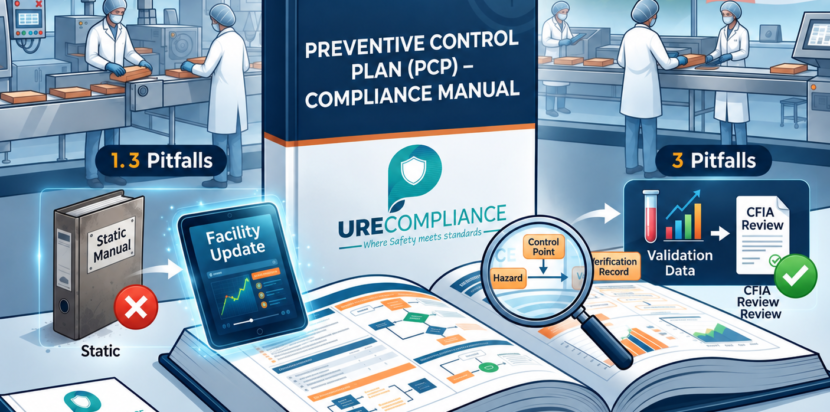
Here are three common PCP pitfalls food businesses should watch for when developing, reviewing or updating their preventive control systems.
1. Treating the PCP as a “Set-It-and-Forget-It” Document
One of the most common mistakes is treating a PCP as a static document that is developed once and then left unchanged.
Food operations evolve. Equipment may be replaced, suppliers can change, new ingredients may be introduced, formulations can be modified, and new products or processes may be added. When these changes occur, the PCP should be reviewed to determine whether the hazard analysis, preventive controls, procedures and records are still appropriate.
The Pitfall: A new ingredient or process is introduced, but the PCP is not updated. During an inspection or review, the written plan no longer accurately reflects what is happening in the facility.
The Better Approach: Establish a routine PCP review process and include food safety documentation in your change-management activities. When significant changes are made to products, ingredients, suppliers, equipment or processes, assess whether the PCP and related procedures need to be updated.
A PCP should reflect your current operation, not the operation you had when the document was first written.
2. Disconnected Control Measures and Monitoring Procedures
Identifying a hazard is only part of an effective preventive control system. The PCP should clearly connect the hazard to the control measure, monitoring activities, corrective actions, verification activities and supporting records, as applicable.
Problems arise when these elements do not clearly connect.
The Pitfall: Your hazard analysis identifies a significant hazard and an important control step, but the monitoring procedure simply states that the control is “checked regularly.” It does not clearly identify who performs the monitoring, what is measured or observed, how frequently it is checked, what criteria must be met, or how the results are recorded.
The Better Approach: Make monitoring procedures specific and practical. Where applicable, clearly establish:
What is being monitored?
Who is responsible?
How is it monitored?
How often is monitoring performed?
What criteria or limits must be met?
Where are the results recorded?
What happens when requirements are not met?Your employees should be able to understand the procedure, perform the activity consistently and know what action to take when something goes wrong.
3. Missing or Inadequate Evidence That Controls Are Effective
Having a preventive control in your PCP is not enough. Where appropriate, there should be evidence supporting that the control is capable of achieving the intended food safety outcome.
This is where businesses sometimes confuse validation with verification. Validation provides evidence that a control measure is capable of being effective, while verification helps confirm that the control is being implemented as intended.
The Pitfall: A business establishes a specific cooking, chilling or allergen-control procedure based mainly on “common practice,” but cannot provide adequate technical or scientific support for the parameters being used.
The Better Approach: Determine what supporting evidence is appropriate for the control. Depending on the process, this may include scientific literature, regulatory guidance, equipment specifications, technical studies, process data, laboratory results or other appropriate evidence.
Where specialized validation, challenge studies, microbiological testing or other technical work is required, qualified external laboratories or technical specialists may be needed.
The important question is: Can you demonstrate why this control is appropriate and effective for the hazard it is intended to manage?
A Strong Preventive Control Plan Should Work in Practice
A strong Preventive Control Plan should do more than satisfy a regulatory requirement. It should provide your team with a practical system for identifying food safety hazards, implementing effective controls, monitoring performance and responding when something goes wrong.
Regularly reviewing your PCP, strengthening the connection between hazards and controls, and ensuring appropriate evidence supports key preventive measures can help reduce compliance gaps and improve overall food safety performance.
Most importantly, your written PCP should reflect what is actually happening in your operation.
Need Support With Your Preventive Control Plan?
Pure Compliance helps food businesses develop, review and strengthen practical Preventive Control Plans and HACCP systems tailored to their products, processes and operations.
Whether you are developing a PCP from the ground up, updating an existing plan, preparing for a CFIA inspection or addressing compliance gaps, we can help you identify practical next steps.
Contact Pure Compliance to discuss your PCP and food safety compliance needs.